The Instituto de Investigaciones Marinas y Costeras (IIMyC, CONICET - UNMdP) provides scientific and technological transfer to the public and private sectors through services, consulting, and agreements. Its more than 30 research groups with expertise across a broad range of topics enable it to address complex challenges in environmental and productive sustainability with comprehensive, evidence-based solutions.
The IIMyC develops an intense transfer of scientific and technological knowledge. Most of the research groups within the Institute carry out knowledge transfer. The IIMyC's wide range of topics and associated capabilities, as a result of its size, also translates into a diversity of transfer activities, which on the other hand are carried out both in the private and public sectors, business (national and international), government (national, provincial and municipal), and intermediate societies (NGOs). These transfer activities are carried out through different administrative channels such as High Level Technological Services (STAN) and Service Agreements, either by CONICET or by the UNMdP.
In addition, the IIMyC has developed a system of scientific-technical reports, with editing and publication rules and ISSN number, which are a useful support for the transfer activities carried out at the Institute (Technical Reports).
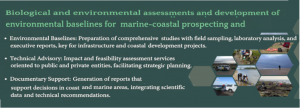
The Institute's transfer capabilities have been consolidated in the following seven areas, which are described below:
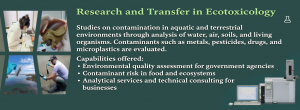
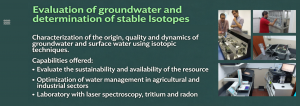
The determination of stable isotopes in water represents a fundamental tool for understanding hydrological processes and sustainable water resource management, with the Hydrogeochemistry and Isotope Hydrology Laboratory (IIMyC, IGCyC, UNMdP) playing a key role in characterizing the origin, dynamics, and quality of water across various Argentine regions by analyzing approximately 1,000 annual samples through STANS instruments for clients including national and Latin American research institutions and universities, water-related public agencies like INTA, and agricultural sectors such as fruit/vegetable and wine producers, while equipped with a laser spectrometer for stable isotope analysis, a recently acquired tritium laboratory donated by the International Atomic Energy Agency, and specialized capabilities for measuring radon-222 as a groundwater discharge indicator, with applied isotopic techniques enabling (1) characterization and differentiation of surface water, groundwater, and meteoric water sources, (2) assessment of resource sustainability and availability, (3) identification of contamination sources, and (4) optimization of agricultural and industrial water management, ultimately supporting precise data-driven decision-making that reduces costs and enhances usage efficiency for sustainable management.


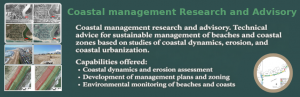
The beaches in our province represent dynamic ecosystems whose degradation stems from both natural causes (seasonal variations and storms) and human activities (intensive urbanization, port construction, coastal defenses, and dune alteration through fixation and leveling). Paradoxically, while beach tourism constitutes a fundamental economic pillar for coastal municipalities, its sustainability faces serious threats from environmental deterioration.
Beach transformations occur across different time scales and result from both natural processes and human activities. Designing and implementing effective mitigation strategies requires consistent, long-term monitoring to better understand coastal dynamics and their evolution. Strategic urban planning, combined with proper land zoning and clear regulations on human activities along the coast, emerges as a fundamental tool to ensure beach environmental sustainability while promoting responsible economic development that benefits communities dependent on these resources.

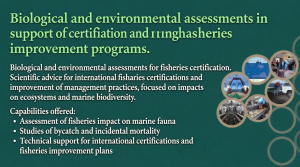
At the government level, IIMyC has played a significant role in developing national and regional action plans for marine biodiversity conservation related to fisheries. Research and advisory services have focused on: (1) fishery interactions with seabirds and marine mammals, including bycatch mortality identification and characterization across various fisheries, plus ecological risk assessments; and (2) developing mitigation techniques and technologies.
The Institute has also conducted extensive studies on bycatch in Patagonian grenadier and scallop fisheries, with active participation throughout fishing operations, producing key findings on: (1) bycatch composition and interactions with avian species; (2) assessment of primary and secondary bycatch species; (3) review of biomass estimation and scallop fishery yield assessment methods; (4) analysis of scallop trawling footprint on the Argentine continental shelf; and (5) development of population models incorporating various fishing pressure impacts.

| Code | High-Level Technological Service Title | |
| ST6144 | Identification and quantification of ichthyofauna | |
| ST3298 | Advisory services on the development of Geographic Information Systems and spatial analysis | |
| ST4409 | Advisory services on marine trophic networks in a context of fishing exploitation | |
| ST5378 | Course on spatial data analysis using QGIS and R | |
| ST2197 | Advisory services on the current status, relevance and consistency of the action plan imposed for the Certification of the Patagonian scallop fishery (Zigochlamys patagonica) by the MSC | |
| ST3720 | Monitoring of marine mammals in contact with seismic vessels | |
| ST5958 | Training of observers for data collection on interaction and incidental mortality of seabirds associated with the southern king crab fishery (Lithodes santolla) certified by the Marine Stewardship Council (MSC) | |
| ST5998 | Analysis of data obtained by onboard observers on levels of interaction and incidental mortality of seabirds associated with fishing activity | |
| ST1928 | Optimization of nutritional quality of feed for fish and crustacean farming | |
| ST1929 | Non-traditional enzymes for the food industry | |
| ST6890 | Training in the development of Management Plans for Protected Natural Areas | |
| ST6462 | Training course «Introduction to the taxonomic, biological and ecological study of sea anemones (Cnidaria, Anthozoa, Actiniaria)» | |
| ST4832 | Advisory services on human environmental impact on the diversity of coastal benthic marine communities | |
| ST6908 | Assessment of fishery resources | |
| ST6640 | Determination of polymer composition in plastic materials by infrared spectroscopy | |
| ST5985 | Determination and quantification of aquatic organisms in inland waters | |
| ST1803 | Advisory services for obtaining and/or maintaining fishery sustainability certifications | |
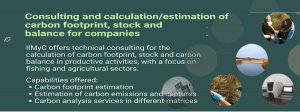
| ST5264 | Advisory services on calculation/estimation of carbon footprint for fishing companies and on actions aimed at its reduction through natural grassland management | |
| ST1265 | Landscape ecology analysis | |
| ST5236 | Estimation of the efficiency of fishing gear for catching benthic resources | |
| ST4162 | Refining of Edible Oils | |
| ST4163 | Extraction and characterization of edible oils | |
| ST1354 | Pollen identification and counting | |
| ST6128 | Identification and characterization of coastal, estuarine and/or marine benthic communities | |
| ST5394 | Scientific advisory services to guide migratory bird conservation actions | |
| ST4638 | Determination of stable isotopes in water | |
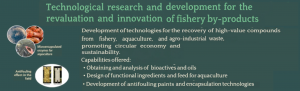
| ST3165 | Valorization of fishery by-products | |
| ST3196 | Proximate chemical analysis of food | |
| ST3197 | Enzymatic Degumming of Oil | |
| ST3703 | Course on marine technology and biotechnology | |
| ST3856 | Quality and freshness analysis of marine resources and products | |
| ST5058 | Comprehensive advisory services on issues related to technology, valorization and innovation of fishery products | |
| ST6199 | Amino acid profile in biological and food matrices | |
| ST6900 | Analysis of fats and oils | |
| ST5086 | Refresher course on ecotoxicology of agrochemicals | |
| ST3080 | Analysis of xenobiotics in fish muscle | |
| ST4545 | Quality analysis of fishery waste for the production of value-added by-products | |
| ST5765 | Scientific advisory services on environmental pollution | |
| ST5454 | Preparation of an environmental baseline report on marine vertebrates in a specified marine area | |
| ST2949 | Advisory services for the conservation and sustainable use of ichthyic species biodiversity in ecoregions | |
| ST3541 | Environmental assessment of aquatic ecosystems | |
| ST4737 | Statistical analysis of assemblages and interaction levels of seabirds associated with the Patagonian scallop fishery certified by the MSC | |
| ST6916 | Identification of vascular plant specimens provided by the contractor | |
| ST3191 | Introductory course to generalized linear models (GLM): an applied approach using R | |
| ST6997 | Training on parasites in marine fishery products from Argentina | |
| STXXX | Silages – Valorization of fishery by-products | |
| STXXX | Fatty acid profile | |
| ST7089 | Advisory services for environmental zoning for vehicle use in beach and dune sectors | |
PR4161 Assessment of interactions and mitigation measures to reduce seabird and marine mammal bycatch in southern freezer trawlers, midwater trawlers, and king crab fishing vessels. FAO.
PR5071 Effects of Ocean Acidification on Patagonian scallop (Zygochlamys patagonica) through experimental approaches. INIDEP.
PR5126 Feasibility analysis for substitute products, including identification of barriers and impact of socioeconomic prohibitions, plus socioeconomic reporting on mercury-added products covered by the Minamata Convention. INTI, IADO, CINDECA, IIESS, IIMYC, CIFICEN.
PR5496 Development proposal for an Environmental Geographic Information System of the coastal area in Lobería District. Lobería Municipality.
PR5794 Promotion of collaborative learning spaces and processes to develop new techno-productive capacities. Ministry of Social Development.
PR5752 Integrated conservation plan development for biodiversity and ecosystem services in Mar del Plata and surrounding areas, incorporating urban green spaces and connecting productive terrestrial landscapes with protected areas. Ministry of Environment.
PR5939 Transfer of Patagonian scallop (Zygochlamys patagonica) samples (n=150) from CONICET to RECIPIENT, collected in Management Unit B (Northern zone, 39°20’S) on the continental slope, Argentina. University of California – Scripps Institution of Oceanography (SIO-UCSD).
PR6342 Blue carbon sequestration potential analysis for the coastal-marine ecosystem of Chubut Province. The Nature Conservancy – TNC
Ecotoxicology and Environmental Pollution
– Short-term basic contracts
Environmental Geology
– Technical advisory agreement between Faculty of Exact and Natural Sciences – Environmental Geology Group – and Quequén Port Management Consortium (OCA No.1533/2020)
Microbiology Laboratory
– Technical advisory contracts between Faculty of Exact and Natural Sciences – Microbiology Laboratory Group – and Beniplast S.A. (OCA No. 360/2022, OCA No. 644/23, and pending contract -2025-)
– Short-term basic contracts