History

The Vascular Plant Herbarium of the Marine and Coastal Research Institute (IIMyCher) originated in 2017 through the merger of two collections housed in the Biology Department of the Faculty of Exact and Natural Sciences (FCEyN) at the National University of Mar del Plata (UNMDP). The first collection began in the 1970s with specimens contributed by students of Systematic Botany and Phanerogams courses in UNMDP's Biology program, under Professors Susana Saravia and Patricia De Vreese. Initially, specimens came from ornamental flora around the University Complex (CUMB) and Mar del Plata city, collected by students during these courses.
In the 1990s, the Vascular Plants course (formerly Phanerogams) was taken over by Dr. María Virginia Mancini, who promoted specimen collection from various Argentine regions during student field trips. This collection also included specimens gathered since the 1980s during research expeditions to Patagonia and Buenos Aires Province by the Paleoecology and Palynology Research Group. Additional specimens came from the Geoecology of Sedimentary Environments Research Group at the Coastal and Quaternary Geology Institute (IGCyC/FCEyN), collected since 2000 from various coastal and continental environments in Buenos Aires Province.
In 2017, an extensive curation process began to standardize the entire collection in Darwin Core format for incorporation into the Global Biodiversity Information Facility (GBIF), now feeding Argentina's biodiversity data portal (www.biodiversidad.ar). Preliminary digitization revealed the collection's diversity, specimen origins, and taxonomic representation. Native taxa were identified using Flora Argentina (www.floraargentina.edu.ar) while exotic taxa were verified via Missouri Botanical Garden's database (www.tropicos.org).
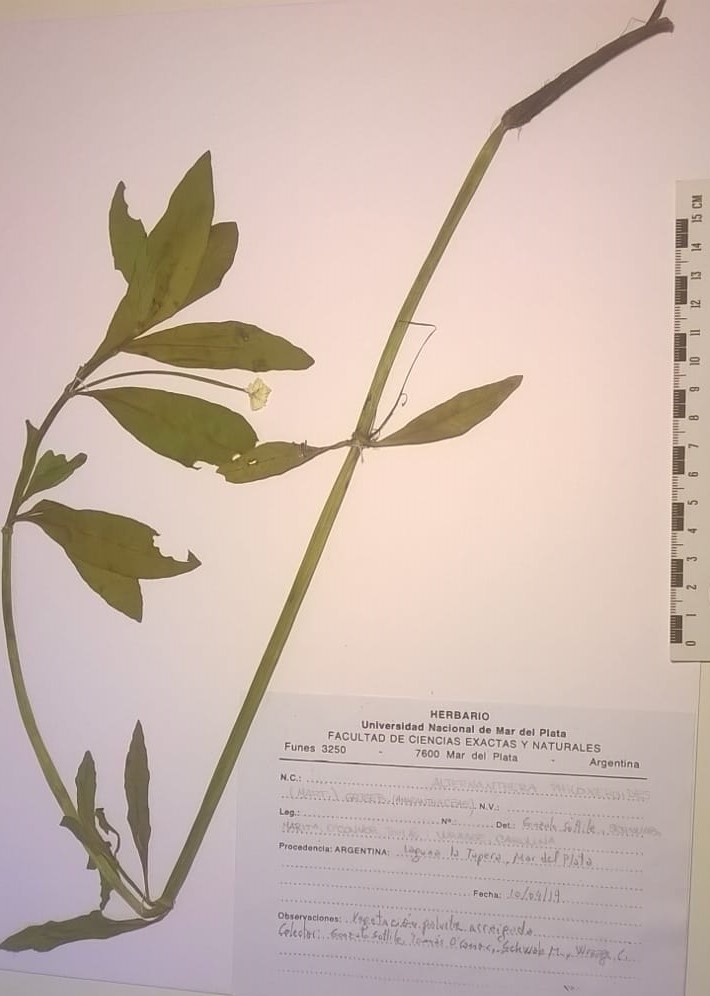
The collection currently contains over 2,000 digitized specimens representing ~140 families, 500 genera, and 1,000+ species. Among tracheophytes, eudicots show the highest family diversity. As of 2025, Poaceae, Asteraceae, and Fabaceae contain the most specimens and genera. Specimens primarily come from Buenos Aires Province (53%), Patagonia (30%), with smaller contributions from NE Argentina (10%) and central/NW regions (7%).
Since 2024, the herbarium has incorporated rocky intertidal macroalgae specimens from Lobería and General Pueyrredón coastal areas, currently housing 19 digitized families (Rhodophyta, Chlorophyta, Ochrophyta-Phaeophyceae) from specific research projects. It also hosts a bryophyte collection of ~20 families from mountainous and coastal environments.
IIMyCher's ongoing GBIF integration provides a research resource for Buenos Aires Province and other Argentine regions, featuring coastal, intertidal, wetland, Tandilia mountain system, and Patagonian forest/steppe specimens. It also serves as a reference for national and international academia.
Internationally recognized by the acronym MDQ in the New York Botanical Garden's Index Herbariorum (http://sweetgum.nybg.org/science/ih/herbarium-details/?irn=255753), this designation is used in GBIF's open-access global biodiversity platform.
Today, IIMyCher supports human resource training and outreach activities related to urban tree heritage and regional forest/nature reserves.
Data Published in GBIF and Biodiversidad.ar
Currently, there are four datasets published on the GBIF and Biodiversidad.AR portals, which can be accessed via the following links:
Dataset 1
GBIF: https://www.gbif.org/es/dataset/fa44bcc6-2ab0-42a6-941a-c5f675ef3845
Biodiversidad.AR: https://biodiversidad.ar/dataset/fa44bcc6-2ab0-42a6-941a-c5f675ef3845
Citation:
Suárez, P. A., Sottile, G. D., Fernández Honaine, M., Álvarez, F., Borrelli, N., & Mancini, M. V. (2019). Collection of Lycophyta, Monilophyta, Gymnosperms, and Monocot Angiosperms from the MDQ Vascular Plant Herbarium of the Marine and Coastal Research Institute (IIMyC, UNMdP-CONICET/FCEyN). Version 1.5. Instituto de Investigaciones Marinas y Costeras, CONICET-Universidad Nacional de Mar del Plata/Facultad de Ciencias Exactas y Naturales. Occurrence dataset https://doi.org/10.15468/bej8hr accessed via GBIF.org on 2021-12-17.
Dataset 2
GBIF: https://www.gbif.org/es/dataset/36fc65f3-ba8d-4c06-917e-6ffe62b63577
Biodiversidad.AR: https://biodiversidad.ar/dataset/36fc65f3-ba8d-4c06-917e-6ffe62b63577
Citation:
Suárez, P., Sottile, G., Fernández Honaine, M., Borelli, N., Álvarez, F., Vásquez, C., Wraage, C., Acuña, A. L., Fernández Montoni, M. V., & Mancini, M. V. (2021). Vascular Plant Collection from the Faro Querandí Natural Reserve (2018–2021) and Arenera Querandí (2009). Instituto de Investigaciones Marinas y Costeras, CONICET-Universidad Nacional de Mar del Plata / Facultad de Ciencias Exactas y Naturales. Occurrence dataset https://doi.org/10.15468/49w9w5 accessed via GBIF.org on 2021-12-17.
Dataset 3
GBIF: https://www.gbif.org/es/dataset/26317600-b0b1-470d-859c-253834b413f
Biodiversidad.AR: https://biodiversidad.ar/dataset/26317600-b0b1-470d-859c-8253834b413f
Citation:
Suárez, P. A., Cudini, V., Matula, C. V., & Sottile, G. D. (2024). Macroalgae Collection from Rocky Intertidal Zones in Lobería District, Buenos Aires (Argentina). Version 1.1. Instituto de Investigaciones Marinas y Costeras, CONICET-Universidad Nacional de Mar del Plata/Facultad de Ciencias Exactas y Naturales. Occurrence dataset https://doi.org/10.15468/rb8z29 accessed via GBIF.org on 2025-02-18.
Dataset 4
GBIF: https://www.gbif.org/es/dataset/f5185371-d898-4b51-9e20-3cf7b6faddc7
Biodiversidad.AR: https://biodiversidad.ar/dataset/f5185371-d898-4b51-9e20-3cf7b6faddc7
Citation:
Suárez, P. A., Cudini, V., Matula, C. V., Meretta, P. E., & Sottile, G. D. (2025). Macroalgae Collection from General Pueyrredón District, Buenos Aires (Argentina). Instituto de Investigaciones Marinas y Costeras, CONICET-Universidad Nacional de Mar del Plata/Facultad de Ciencias Exactas y Naturales. Occurrence dataset https://doi.org/10.15468/8xx2yv accessed via GBIF.org on 2025-02-18.
Team Members
| Role | Name | Position | Affiliation |
|---|---|---|---|
| MDQ Herbarium Lead Curator | Lic. Patricia A. Suárez | Research Support Professional (CONICET) | IIMyC, Plant Diversity Services Lab |
| Curator | Dr. Gonzalo David Sottile | CONICET Associate Researcher, UNMdP Adjunct Professor | Paleoecology & Palynology Group, FCEyN, IIMyC-UNMdP |
| Curator | Dra. Mariana Fernández Honaine | CONICET Independent Researcher | Sedimentary Environments Geoecology Group, IIMyC (UNMdP-CONICET), IGCyC (UNMdP-CIC) |
| Curator | Dra. Natalia Borrelli | CONICET Associate Researcher, UNMdP Adjunct Professor | Sedimentary Environments Geoecology Group, IIMyC (UNMdP-CONICET), IGCyC (UNMdP-CIC) |
| Curator | Dra. Fernanda Álvarez | CONICET Assistant Researcher | Sedimentary Environments Geoecology Group, IIMyC (UNMdP-CONICET), IGCyC (UNMdP-CIC) |
Contact:
herbario@iimyc.gob.ar | psuarez@conicet.gov.ar
Internships
Students who have collaborated with the herbarium as interns:
| Name | Period |
|---|---|
| Jennifer Saya | 2017–2018 |
| Tomás O’Connor | August 2018 – July 2019 |
| Gonzalo Burgos Herrera | August 2018 – July 2019 |
| Carolina Wraage | March – July 2019 |
| Marita Schwab | March – December 2019 |
| Azul Acuña Hamann | March – December 2019 |
| Carolina Vásquez | March 2019 – April 2021 |
| Nazareno A. Díaz | September 2024 – December 2024 |
Biologists Network (BER)
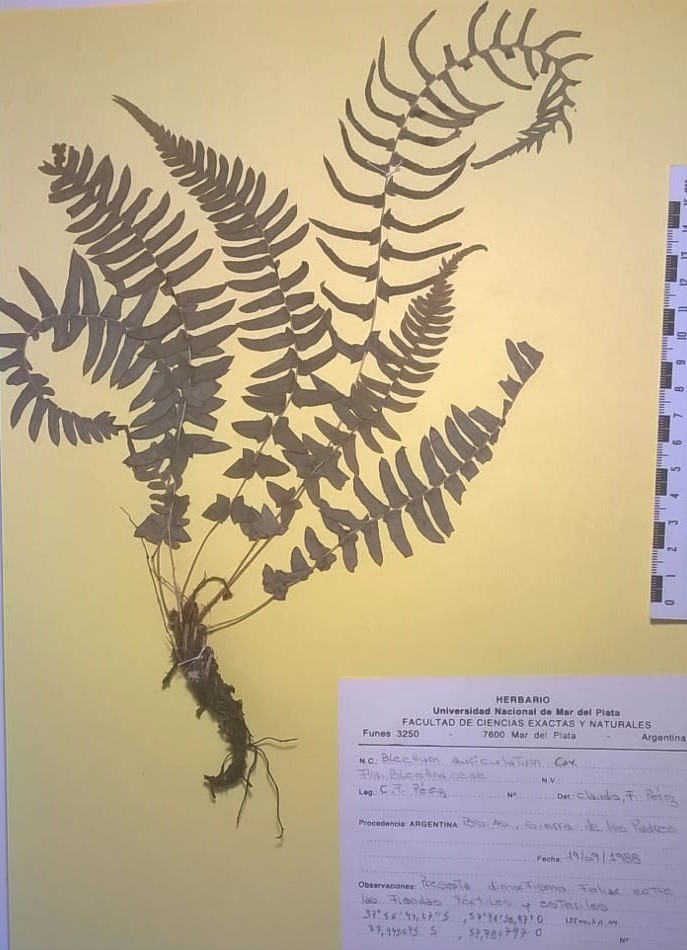
2018 Ferns Project
2024 Germplasm Bank Initiative
2024 Herbarium Poster Project
Alternative version with more complete translations:
Biologists in Network (BER)
2018 Ferns Study
2024 Seed Bank Program
2024 Herbarium Display Project
Conferences
Argentine Botanical Conferences
IV Patagonian Biology Conference 2018
Data
Publications
SOTTILE, G. D., T. O’CONNOR, G. BURGOS HERRERA, C. P. WRAAGE & P. A. SUÁREZ. 2024. Ferns and lycophytes of southeastern Tandilia System (Buenos Aires, Argentina): composition, biogeographic affinity and ecological diversity patterns. Bol. Soc. Argent. Bot. 59: 345-374. DOI: https://doi.org/10.31055/1851.2372.v59.n3.44744
Gallery
 |
 |
 |
 |
 |
 |