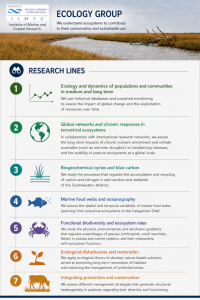
Research lines
Ecology and dynamics of populations and communities at medium and long-term scales: We use historical databases and sustained monitoring to assess the effect of global change and resource exploitation over time.
Global networks and chronic responses in terrestrial ecosystems: In collaboration with international research networks, we evaluate the long-term impacts of chronic nutrient enrichment and climate anomalies (such as extreme droughts) on biodiversity, biomass, and stability of grassland ecosystems at a global scale.
Biogeochemical cycles and blue carbon: Study of the processes regulating carbon and nitrogen accumulation and recycling in salt marshes and wetlands of the Southwestern Atlantic.
Marine trophic webs and oceanography: Assessment of the spatial and temporal variability of marine food webs, ranging from estuarine ecosystems to the Patagonian Shelf Front.
Functional biodiversity and ecosystem roles: Study of the physical, environmental, and stochastic gradients that regulate species assemblages (arthropods, small mammals, fish) in coastal and marine systems, and their relationship with ecosystem functions.
Disturbances and ecological restoration: Application of ecological theory to develop nature-based solutions aimed at enhancing long-term habitat restoration and improving protected area management.
Integrating production and conservation: Evaluation of different management strategies that generate structural heterogeneity in grasslands and their effects on diversity and functioning.